Why Nothing Works: Who Killed Progress- and How to Bring it Back
Just finished reading this today as an audiobook! I recently found this book via Ezra Klein's podcast, and it did not disappoint! Anyone interested in really looking at why government can't seem to do anything should read this book.
BOOKS
Justin Kendall
6/3/20262 min read
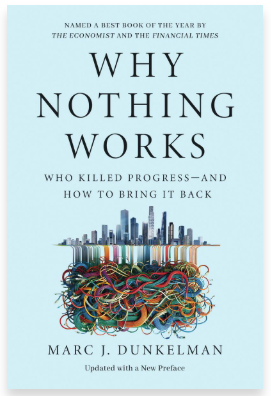
I've been a fan of Ezra Klein's podcast for quite a while and his takes on why gridlock exists in our country. Back in April, I listened to the episode he did on the book "Abundance" one year out- what they got right, what they wished they could go back and improve, where they maybe could have used some more detail. Part of the discussion was led by Marc J. Dunkelman, the author of this book. I really enjoyed the discussion in the podcast, and felt impelled to pick this up. You can watch the podcast here: https://youtu.be/F377QOw7dvk?si=R8q_w2ODVbc8X97d
If you want to break through the partisan name-calling and really take a look at what we need to do as a country to move us forward, you should take the time to read this book.
At its core, it examines several periods in our history not through a partisan lens, but through progressivism's two competing impulses: Hamiltonian versus Jeffersonian.
Hamilton wanted a strong centralized government that could bulldoze anyone in opposition so things could get done. Jefferson wanted a weak central government where the power to do things happened as close to the local level as possible. Each impulse has its place in the world. As progressives today, we go between these two ideas constantly, and sometimes it can be confusing or difficult to parse the words to describe them. We want Hamiltonian structure- large, centralized, bureaucracy when it comes to things like health insurance, education standards, and climate policy. In areas of land/housing development and AI datacenters we advocate for Jeffersonian systems to keep power local.
What this book examines is our use of each of these impulses as applied to specific policy areas and makes the case that we very often have, as progressives, shot ourselves in the foot by making it so easy to veto any project for any reason through court challenges that drag on for years, that it has become nearly impossible to get anything big accomplished. In partisan world, Democrats have taken the position of trying to defend big, centralized government 100% of the time while Republicans run on deregulation and tearing down big government 100% of the time. Both of these are bad generalizations that hurt everyone. It traps Democrats into trying to defend clearly broken systems and traps Republicans into tearing down centralized structures that actually work. The end result is that nothing actually gets done no matter how good the project or how committed everyone is to see it done. When nothing works, it's very easy for people like Donald Trump to come in with promises that they're going to fix everything and get elected, because people that see gridlock want someone that portrays themselves as someone that can cut through all the noise and get things accomplished.
We've got to move past these simplified views of policymaking and make it so that in the case of big things, people have a voice in shaping them, but not a veto. We've got to show how government can work, without forcing ourselves to defend clearly broken centralized structures. And sometimes, the person we don't like is going to end up in power, and they're going to end up being able to do things too. In the end, in many cases, getting absolutely nothing done is worse than letting the person we don't 100% agree with metabolize the available info and make a decision.