Tippecanoe Emergency Ambulance Services Needs Change
This is a re-post from my campaign website from running for county commissioner earlier this year.
EMS
Justin Kendall
3/1/202611 min read
Overview
The emergency ambulance services provided by the Tippecanoe Emergency Ambulance Services (TEAS) bills you up to 50% more and takes more than 50% longer to respond than the fire department-based EMS providers in the county.
Emergency Medical Services (EMS) are essential services for the public, providing emergency ambulance runs for residents of the county. After seeing allegations against Tippecanoe Emergency Ambulance Services (TEAS) of poor response times, staff burnout, unclear management structure and unresponsive county commissioners by residents of the county, I dug in to find as much concrete information as I could to try to help get to the bottom of the issues.
These services are so important, and I've never been someone that is OK with sitting around waiting for someone to tell me to go work on fixing issues when I find out about them and can help fix them. Unlike others who say they're going to do something someday, or have watched things be bad for 30 years working in County government but never did anything, I'm committed to being proactive to address critical services like these that affect the everyday lives of people. Just imagine what we can accomplish together for our county if you elect me as your next commissioner.
After reviewing detailed dispatch data, conferring with public officials in the county that work with EMS and former TEAS employees, I think we can conclusively say there is a problem here. Commissioners have allowed their chosen primary provider of EMS to provide substandard response times with zero public transparency or accountability for far too long.
I think our current county commissioners owe the public an explanation on the state of these services and what they're doing to improve them for the future. Our state legislature has been considering making EMS an official duty of the county commissioners, to clarify the existing gray areas in law, for the last two legislative sessions. We as a county have other options for providing this service that would be more transparent and accountable to the residents, and I think it's time we start looking into what that would look like.
The rest of this page seeks to give you as much of the detail I've uncovered as possible, so the public can hopefully get some improvement.
Terms
What is EMS?: EMS stands for Emergency Medical Services, which provide emergency ambulance services.
What is TEAS?: The "Tippecanoe Emergency Ambulance Services" (TEAS) is an assumed business name of Franciscan Health, and has been given an effective monopoly by the County Commissioners for providing EMS, for more than a decade. All operations of TEAS is done by Franciscan Health and all employees of TEAS are Franciscan employees.
It does not have a complete monopoly, as municipalities other than the county government (because the county has formed a legal agreement that they will not establish any competing EMS) have the legal authority to establish EMS for their residents because state law is unclear on whose exact responsibility it is and to what extent. As such, there are a few fire department-based EMS throughout the county providing these services for their residents where they felt there was a need. This includes the Purdue University Fire Department, the Wabash Township Fire Department, and Volunteer Fire Departments (VFD) in West Point, Clarks Hill/Lauramie Township, and Otterbein Area.
What is the standard?: The standard metric for EMS on-scene response times is to be on scene within 8 minutes, 90% of the time.
What's Wrong with TEAS?
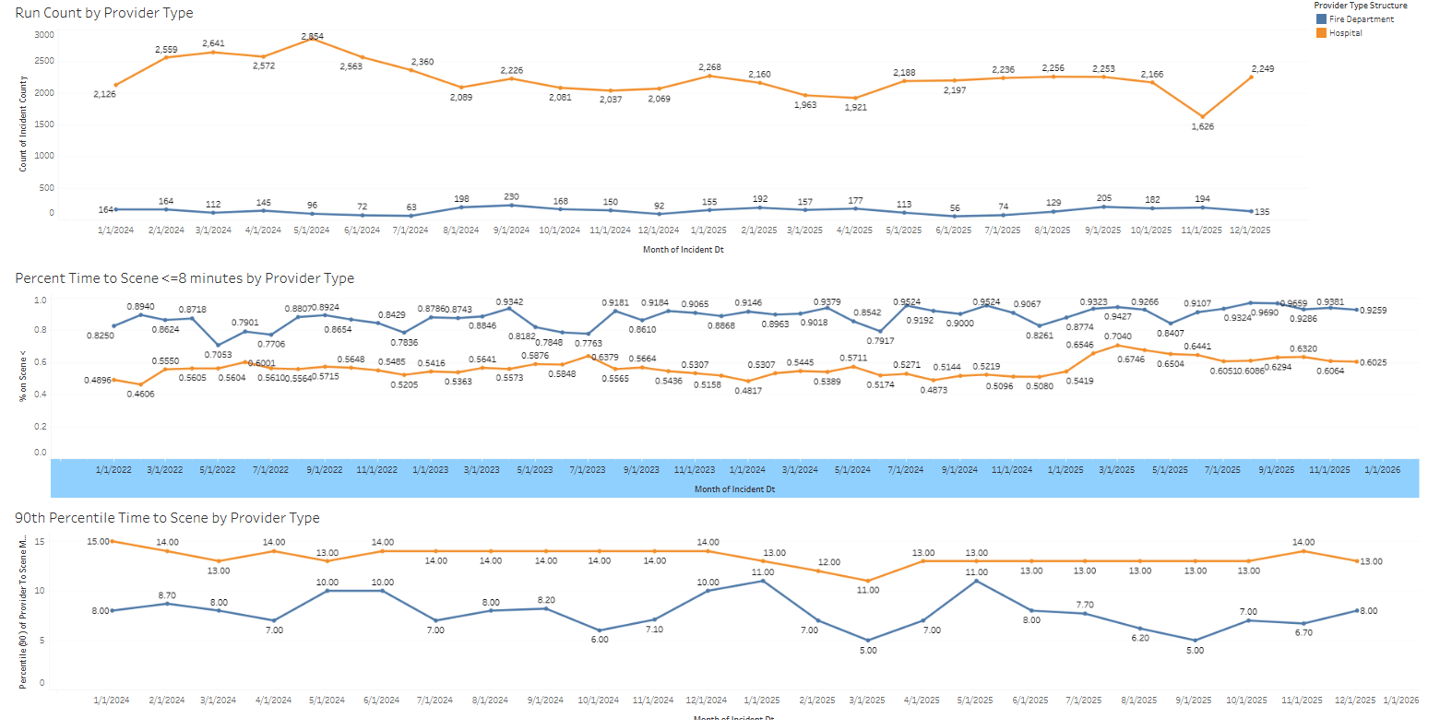
Response times don't keep up with other EMS providers in the county: After pulling detailed EMS dispatch data from the Indiana Performance Management data hub and analyzing it (Linked in the "Tippecanoe County Visuals" section below), it shows that in 2025, TEAS only arrived on scene within 8 minutes approximately 65% of the time, not 90% of the time. If you look at what their 90th percentile of calls take to arrive on scene, TEAS arrives on scene within 13 minutes 90% of the time, instead of 8- more than 50% slower. On top of this, TEAS employees have such high workloads that when they get a call, they're most likely already sitting in the ambulance and can start heading toward the scene immediately. In the fire departments, their workload of runs is much lower and many times are not sitting inside the ambulance when a call comes in. They might be doing training or other station work when a call comes in and need to travel across the building to get to their ambulance before they can start driving. If you take this into consideration, the numbers for TEAS look even worse. See the visuals I've put together further down on this page.
When looking at the same data for the fire department-based EMS in the county, the fire departments are hitting the 8 minute time to scene approximately 93% of the time. Why can't TEAS?
TEAS costs more: With the help of public records obtained from one of the fire department-based EMS in the county and correlating with real ambulance bills, TEAS appears to be charging the residents of this county up to 50% more than the fire department-based EMS that operate in the county, based on the complexity of the required EMS response.
The county also sends money to TEAS each year: The county sends $100,000 each year to TEAS from the county economic development fund, on top of it costing more. See the "County / TEAS MOU" link in the "Data" section below.
TEAS works its staff harder and pays its staff less, leading to significant burnout:
Workload and Pay: TEAS crews average 6–10 calls per 12-hour shift, with each call requiring 45–60 minutes to complete. Paramedics are paid between approximately $55,000 and $77,000 per year, while EMTs are paid between approximately $38,000 and $59,000 according to salaries submitted by past employees on Glassdoor and confirmed by former TEAS employees.
Salary Comparison: In contrast, Wabash Township Fire Department pays paramedics $76,000 to $79,000 per year for a forecasted volume of 3–5 runs per 24-hour shift.
Organizational Structure: While there is a governance board that says it's providing governance to the operations of TEAS, the whole structure seems problematic. TEAS (The assumed business name operating EMS under Franciscan Health) receives governance leadership by the separate 501(c)(3) non-profit "Tippecanoe Emergency Ambulance Services, Inc". Its board consists of:
One of the county commissioners as a Class B member
Representatives from Franciscan Health as Class A members
Representatives from IU Health as Class A members
One representative from Lafayette as a Class C member
One representative from West Lafayette as a Class C member
See "County / TEAS MOU" below in the "Data" section for documentation.
While IU Health is a member to this "governance", it's unclear whether IU Health has any real say in the operations of TEAS. All of the operations of TEAS happen inside of Franciscan Health. All employees, equipment, everything operationally, is done via Franciscan Health. I've reviewed the TEAS, Inc. non-profit public documents, and they confirm that the TEAS, Inc. governance organization has no financial activity itself, and that the governance board does a budget review of TEAS operations (Without the "Inc" in the name) on a yearly basis. Because everything is done within Franciscan, do any of the other members to this governance really have any say in what happens operationally?
Regulatory Deficiencies: Indiana Administrative Code (836 IAC 1-11-2(e)) requires BLS nontransport organizations to maintain agreements with an ambulance service provider organization. TEAS currently lacks these mandatory agreements with most, if not all, local fire departments.
Monopolistic Behavior: The TEAS, Inc. non-profit entity has bound the County government from establishing any competitor EMS organizations in their by-laws (I have copies). Because of this, TEAS has prevented the inclusion of private ambulance services that already exist in the county from the 9-1-1 dispatching process. As a result, when TEAS is unable to respond due to insufficient staff, county residents have to sit and wait, rather than let one of the private ambulance companies assist.
Final Result: Fellow county residents that need emergency ambulance service are getting up to 50% higher bills and getting more than 50% worse response times from TEAS than the fire departments operating in the county. All while consistently burning out their staff. Other counties of similar population size, like Hendricks county, have an all fire department-based EMS and are able to hit appropriate on-scene response times.
I believe the response times for emergency ambulance services by TEAS are unacceptable, there is not enough transparency on how these essential services operate, and our elected officials that are supposed to be providing governance of these services owe us all some explanation. I believe we need to put a County Commissioner in office that doesn't sweep essential services under the rug and let them fester to the detriment of the residents of the county.
What do I want to see happen?
I think the current commissioners should be providing the public with the following:
An explanation of what current expectations they have communicated to TEAS regarding response times and quality of service for the residents of the county.
An explanation of why getting an ambulance run from TEAS is the most expensive in the county, yet has more than 50% worse response times for arriving on scene.
An explanation of what the county commissioners are doing currently with TEAS to improve these response times.
An explanation for why we should continue to have TEAS operate an effective monopoly on these services in the county instead of looking at alternative methods of delivering services, such as fire department or county-based EMS that has to be transparent with, and responsive to, the residents of the county. Just like we expect for fire and police.
An explanation of why the county is paying TEAS $100,000 each year out of economic development funds, given their higher costs and worse response times. See the "County / TEAS MOU" link in the "Data" section below.
Disclosure of detailed budgetary information, annual billing collections, staffing and administrative costs.
Why am I drawing attention to this now?
A couple of months ago, as I was contemplating running for county commissioner, I started going through the most recent public county commissioner meeting recordings. During one of those meetings, I encountered one of our fellow residents, Eric Ehrman, giving public comment. He was asking the current commissioners why they would not respond to him with information about TEAS as he had been requesting via email. He indicated that response times seemed long, that the organization was unable to retain staff to provide appropriate services, that Franciscan Health operated, retained the profits for, and dominated their governance board to the exclusion of all other parties, among other things.
Because of the response by the current commissioners to the questions, the serious allegations for these essential services, and my desire to better understand what the commissioners are doing today in their role, I decided to look into this subject and see if I could find concrete data for what the response times really are and how this organization works.
I tracked that data down and was really surprised by what I found. I reached out to one of the elected officials that I know has been focused on improving public safety in our community, Wabash Township Trustee Angel Valentin, to get more background information on the state of fire and EMS in our community and to make sure I was interpreting the State data appropriately. He was able to help fill in many more details from public records and their township's EMS.
As I've talked to residents 1-on-1 as I've canvassed neighborhoods these last several weeks, quite a few of the people that answered their doors to talk to me relayed their own bad experiences with emergency ambulance services in the county. It's become clear to me that this is a widespread issue that the people of this county want to see addressed.
EMS Landscape in Indiana
EMS providers have been a hot topic for the last several years. In 2024, the state passed Public Law 67, requiring county commissioners and EMS providers to provide data about their services to the state (See "Data" section below for link to results). In 2025 legislation was introduced and in 2026 legislation made it through the House (but not the Senate, prior to the end of the session) which would specify that EMS is an essential service and task county commissioners directly with overseeing this function in each county. See https://iga.in.gov/legislative/2026/bills/house/1251/details. I believe that our county needs to take the lead and fix these response times, as it seems that state lawmakers are heading that direction.
Tippecanoe County Visuals
You can find visualizations in full here that I've assembled for the last several years of EMS dispatch data data: https://public.tableau.com/app/profile/justin.kendall2389/viz/EMS_Run_Analysis_Indiana/TippecanoeDashboard. See notes on fields in the "Data" section.
All of these visualizations are based off of the data obtained from the Indiana Management Performance Hub, documented as "State Raw Dispatch Data" in the "Data" section below.
Here are examples
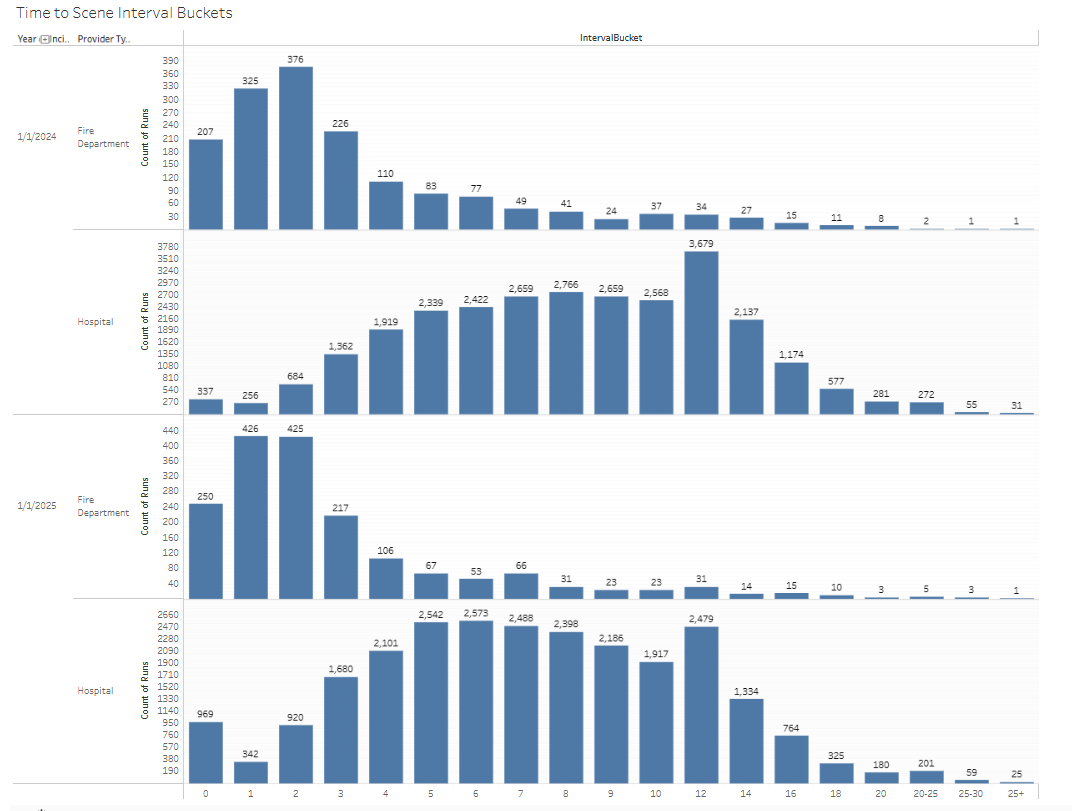
Note - In these graphs, the "Hospital" provider type is TEAS. It's the only hospital-based EMS that operates in the county that performs emergency ambulance runs. "Fire Department" is the various fire departments operating EMS programs throughout the county.
These line graphs show the basics of the number of runs performed and the basics of on-scene response times, by month, for 2024 and 2025.
This bar graph illustrates the response time curve for ambulance runs. Note that the fire department runs are concentrated in the 1-3 minute range and drops off dramatically from there. The TEAS runs are very much consistently higher.
Examples from Other (Similarly Populated) Counties
All we have to do is look to other counties in the state and we can see that there are other similarly sized counties that are able to hit appropriate response times. Here are some facts:
If you use the visuals I created at https://public.tableau.com/app/profile/justin.kendall2389/viz/EMS_Run_Analysis_Indiana/TippecanoeDashboard, you can use the tabs on the dashboard to select any county in the state. Hendricks and Vanderburgh county are both very similar to Tippecanoe in population and each have different mixes of EMS providers. Take a look at it yourself!
Hendricks county has similar population and has a completely fire department-based EMS system. They're able to hit appropriate response times.
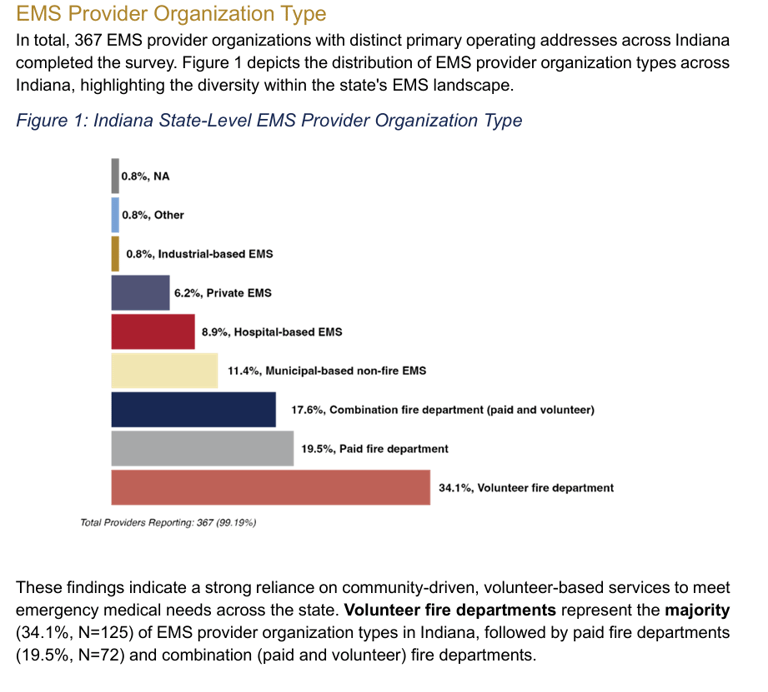
In the statewide EMS study that was done in 2024 (linked below in the "Data" section), you can see that fire departments provide the majority of the EMS runs in the state. Hospital-based EMS, like TEAS, only accounted for 8.9% of providers, so entities like TEAS are in the minority in the state.
In Vanderburgh county, the response times of their EMS providers were consistently high also (You can see this in my visualizations by going to the tabs and changing the county filter and including all provider type structures, here https://public.tableau.com/app/profile/justin.kendall2389/viz/EMS_Run_Analysis_Indiana/TippecanoeDashboard). Because of the ongoing poor response times, the city of Evansville decided to make their own EMS, which is set to go online in July of this year. See the following news articles:
Data
Here is the associated data for you to validate my work:
TEAS Tax Exemption Application (Including by-laws and other supplemental docs): https://assets.zyrosite.com/ysvYnhIMlJtxWPD8/teas_form1023-uF6LiUAI6SNqGxZE.pdf
County / TEAS MOU: https://www.tippecanoe.in.gov/DocumentCenter/View/52166/Memorandum-of-Understanding-with-Tippecanoe-Emergency-Ambulance-Services?bidId=
Statewide EMS Study in 2024: There was a big study that was done in 2024 by the state, which had all of the counties provide data on their ambulance services. See Indiana Public Law 67 - 2024 Data Report. This has some interesting insights, but the data is grouped together by "districts" rather than counties. There's some good executive summary context on the state of the state on page 4 of that data report. Our district is district 4, and its data starts on page 27 of the data report pdf. The other informative piece is Appendix B, on page 34 of the pdf, which outlines factors reported for longer than average response times.
State Raw Dispatch Data - You can find the entire dataset on the Indiana Management Performance Hub here: https://hub.mph.in.gov/dataset/emergency-medical-service-runs.
Notes on fields - In the dataset, the provider names are "anonymized" and do not contain the actual name of the provider. The way we can tell TEAS data vs fire department data is by looking at the combination of the following two fields:
"PROVIDER_TYPE_SERVICE" - This field indicates the type of service provided. Calls to 911 for emergency ambulance service fall under the "911 Response (Scene) with Transport Capability" category. Non-emergency ambulance services fall under a different service type.
"PROVIDER_TYPE_STRUCTURE"- This field indicates the type of provider. In our county, there is only "Fire Department" and "Hospital". TEAS is the only hospital provider type that performs "911 Response (Scene) with Transport Capability" EMS runs in our county.
Data Dictionary: https://hub.mph.in.gov/dataset/8404e4ae-c244-48c1-95ee-c2eff5e177e6/resource/60731e9b-47ee-48c0-9b2d-b8b33b99a29e/download/data_dictionary.csv